

| Le Figaro Littéraire - March 08, 1925 |

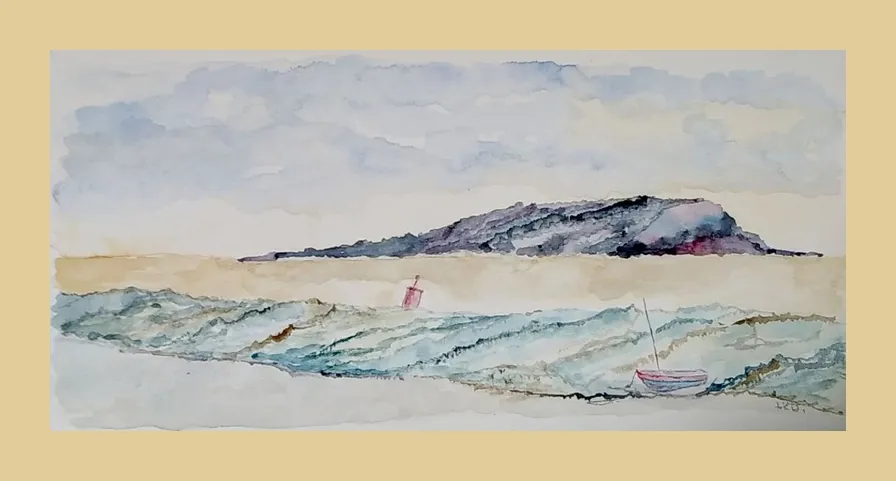
The Villequier tragedy The recent death of Georges Victor Hugo has brought attention back to the family of the great poet. It is therefore curious to recall the memory of his eldest daughter who died so tragically and whose Figaro recently published some curious letters: On Saturday, September 9, 1843, in the dining room of the "Café de l'Europe" in Rochefort, a traveler, who had just sat down at a small table and ordered his lunch, was looking through the newspapers while waiting to be served. Those around him suddenly saw him suffer, putting his hand to his heart as if to stop it from bursting. He got up, ran straight to the ramparts and, there outside the city, continued to walk for a long time like a madman. The poet hurriedly set off on the return journey. All the seats on the stagecoach having already been reserved, he had to hoist himself up as best he could next to the luggage. On the morning of Monday, September 4, Charles Vacquerie, an excellent swimmer and a good boatman, was returning by boat from Caudebec, with his young wife, his uncle, Pierre Vacquerie and his uncle's son. The walk had continued without a breath of air, the sheets of the sails attached, when suddenly, at the height of the "Dos d'Ane", an unexpected gust came. In a few seconds, it capsized the boat, whose mast immediately touched the bottom, the water not being, at this point, more than eight feet deep. So much so that one side of the boat emerged.
A few minutes later, a boatman, attracted by cries of distress, saw the wrecked boat from the shore and went to get reinforcements. The boat was put back on its keel, and the body of Pierre Vacquerie was found under the sail. His hand was still holding the rudder. As for his young son, he had disappeared, like Charles Vacquerie and his wife. The lifeless body of the latter was brought back at the first stroke of the seine. Her only injury was a bad scratch on her neck. The contraction of her fingers and the bruises on her hands showed that she had had to cling to the submerged edge. Her dress was in pieces, one of her stockings in tatters. A closer examination revealed that one arm was dislocated. Charles Vacquerie was found next to his wife, his eyes fixed and his arms thrown back convulsively. He had dived six times in a row, peasants, from afar, had glimpsed the scene and were able to specify these details to try to detach the little hands clinging to the overturned boat. "Charles Vacquerie," stated Alphonse Karr in an article published the day after the accident, "did not want to be saved." And everything suggests, in fact, that this experienced swimmer let himself sink out of despair. It will not be said that he died like this, The horror of this rapid tragedy, which darkened the poet with fierce grief, and overwhelmed both Mrs. Victor Hugo and grandfather Foucher, aged in a few days by as many years as his dead granddaughter, must be reread, in order to fully understand it, the verses written for this adored daughter. Hugo was twenty-two years old when she came into the world, in 1824. She was, he told us, his "morning star, the child of his dawn", because his very first child had lived only a few days. The birth of Léopoldine is contemporary with the last Odes and Ballades, in which the poet was to write: One guesses, from her eyes full of a pure flame, These are the verses that the poet wanted to see engraved at the bottom of a charming lithograph by his friend Louis Boulanger, which represents Léopoldine at four years old. "She was as beautiful as a beautiful day," if we are to believe Jules Janin. Victor Hugo, in Contemplations, likes to describe his two daughters, Léopoldine and Adèle, the older and younger sisters, sitting at the threshold of the garden in the house at Saint-Prix, near Montmorency: One like a swan and the other like a dove, Every morning Léopoldine came to find him in his room, cheering him up with a "Good morning, my little father" that interrupted his labor. But in vain did she open her books, take up her pen, and arrange her papers: the dear presence did not drive away inspiration: She made my fate prosperous, My work light, my sky blue. The poet would sometimes find, among his manuscripts, some sheet scrawled with a crazy arabesque: And many a blank page, crumpled between her fingers, Léopoldine was seven years old when Feuilles d'automne appeared, all illuminated by the poet's tenderness for the child, this "beautiful angel with the golden halo". Is there any need to recall the stanzas where he speaks of the sadness of this depopulated hive "the House without children"? These verses sing in all memories. He had dedicated to Léopoldine the Prayer for All, written in June 1830, seven years before his daughter's first communion in the little church of Fourqueux: It is the hour when children speak with angels, It was one of the favorite poems of the child who had become a young girl. "I remember," wrote Alfred Asseline, "an evening in the country when she recited the Prayer for All to us. She was sitting near the window, in a blue dress, with the book open on her knees. When her memory failed her, she leaned over to find the printed verse; and the light of the lamp gently illuminated her forehead and her hair." A year after the catastrophe, on the very day of the anniversary, Hugo wrote one of the most famous poems of the Contemplations. After the first revolts, here is her pain wrapped in a dark resignation. The poem - Mr. Grillet was the first to point this out - is full of reminiscences of the Book of Job. And Veuillot himself did not hesitate to find in it the most Christian verses that there were in our language: I cease to accuse, I cease to curse, Short appeasement in the story of a weary and discouraged soul that revolt quickly seizes: If this God did not want to close Even glory does not console him. He thinks constantly of the small tomb towards which he walks on each birthday, "alone, unknown, his back bent, his hands crossed", of the "recumbent" whose voice he hears everywhere: Perhaps, livid and pale, A whole book of Contemplations is the deep echo of this sorrow that inspired the poet some of his most beautiful verses. And it is through this that the drama of Villequier escapes from the simple news item to enter literary history. It is useful to evoke it in all its tragic horror, when we piously unroll the shroud of superb stanzas that the great poet has woven for this dear nuptial tomb. Charles Clerc.
|
| Back March 08, 1925 |